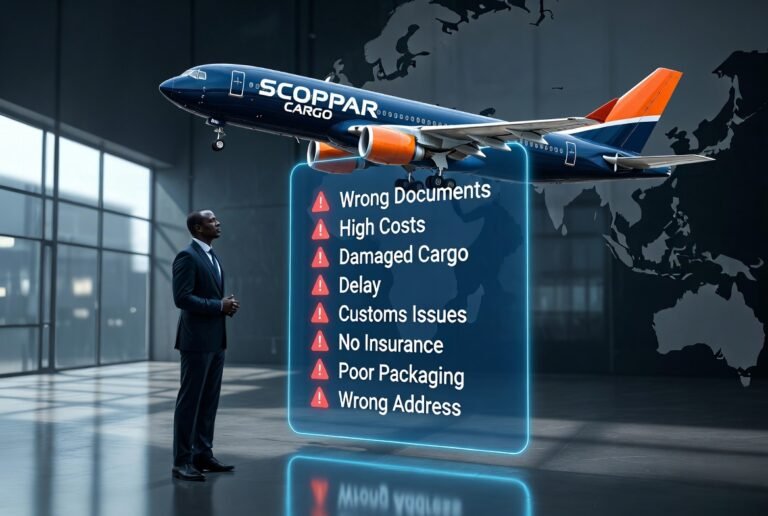
Scoppar vs Traditional Forwarders: What Makes a Specialized China–Africa Air Cargo Partner Different

Most freight forwarders in China handle cargo to many destinations — Europe, the US, Southeast Asia, the Middle East, and Africa. Africa is often just one more lane among dozens.
A specialized China–Africa air cargo partner works differently. The focus is narrower, the operational knowledge is deeper, and the service is built around the specific realities of this trade lane.
Here’s how the two approaches compare in 2026.
1. Route Knowledge and Control
Traditional forwarders usually book space on major passenger or multi-stop freighter networks. They rely on general airline allocations and may have limited influence when space tightens.
Specialized partners concentrate on specific corridors (such as Ezhou → Lagos → Douala). They develop stronger relationships with the operators flying these routes and often have better visibility on actual freighter capacity.
2. Pricing Transparency
General forwarders frequently quote base rates and add multiple surcharges later. The final cost can differ significantly from the initial number.
Specialized operators tend to work with clearer all-in structures because they understand the full cost stack on their core lanes and can explain it upfront.
3. Handling of African Destinations
Central and West African airports have their own documentation, customs, and handling realities. A generalist may treat Douala or Kinshasa the same way they treat major European gateways.
A focused partner is more familiar with local requirements, common bottlenecks, and practical solutions at destination.
4. Communication and Problem Solving
When something goes wrong (delay at hub, documentation issue, space change), response quality matters.
Specialists usually have shorter decision chains and more direct access to the people operating the flights. This often leads to faster and more practical solutions.
5. Product Focus
Traditional forwarders sell a wide menu of services. Africa is rarely their main priority.
A specialized China–Africa partner builds its commercial and operational model around this corridor. The product is clearer, the team is more focused, and continuous improvement is directed at the same set of routes.
Comparison Summary
| Aspect | Traditional Forwarder | Specialized China–Africa Partner |
|---|---|---|
| Route focus | Broad, many destinations | Narrow and deep on Africa lanes |
| Capacity access | General airline allocations | Stronger position on specific freighters |
| Pricing style | Often base + many add-ons | Clearer all-in approach |
| Destination expertise | General knowledge | Higher familiarity with African airports |
| Problem response | Can be slower / multi-layered | Usually more direct |
| Strategic priority | Africa is one of many | Africa is the core business |
When a Specialist Makes More Sense
A specialized partner is usually the better choice when:
- Your cargo regularly moves from China to West or Central Africa
- You value predictable transit times and clearer communication
- You want fewer surprises on final cost
- You prefer working with a team that understands both ends of the corridor
For occasional or very diverse shipments to many global destinations, a large traditional forwarder may still be convenient.
Final Thought
The China–Africa air cargo market in 2026 is maturing. Importers and agents no longer have to accept generic service on a complex lane. Partners who dedicate themselves to this corridor can offer sharper execution, better information, and more reliable outcomes.
Choosing between a generalist and a specialist is ultimately a choice about focus versus breadth.
Looking for a focused China–Africa air cargo partner?
Scoppar operates with a clear concentration on the Ezhou–Lagos–Douala corridor and related Central African destinations.
WhatsApp: +237 693 000 027 Email: care@scoppar.com Website: www.scoppar.com
Share your shipment details and we will show you how a specialized approach works in practice.