How to Ship Cargo from China to Douala / Central Africa in 2026 (Complete Guide)
Shipping from China to Douala (DLA) and other Central African destinations is faster and more predictable in 2026 thanks to improved digital customs systems and stronger hub connections. This guide covers the full process with 2026-specific updates, practical calculations, and regional comparisons.
Quick Summary Table – Key Steps & Timelines
| Step | Action | Typical Timeline | Notes (2026) |
|---|---|---|---|
| 1 | Choose route & service | 1 day | Ezhou → Lagos → Douala preferred |
| 2 | Prepare documents | 1–3 days | Must use GUCE / CAMCIS |
| 3 | Book space & confirm rate | 1–2 days | Book early in peak seasons |
| 4 | Pickup / warehouse in China | 1–3 days | Door-to-airport common |
| 5 | Flight + hub transfer | 3–6 days | Via Lagos hub |
| 6 | Arrival + customs clearance Douala | 1–4 days | Digital processes faster |
| 7 | Final delivery | 1–2 days | Door-to-door option available |
| Total | Airport-to-Airport | 4–8 days | |
| Total | Door-to-Door | 6–12 days |
1. Choose the Right Route in 2026
The most efficient corridor remains:
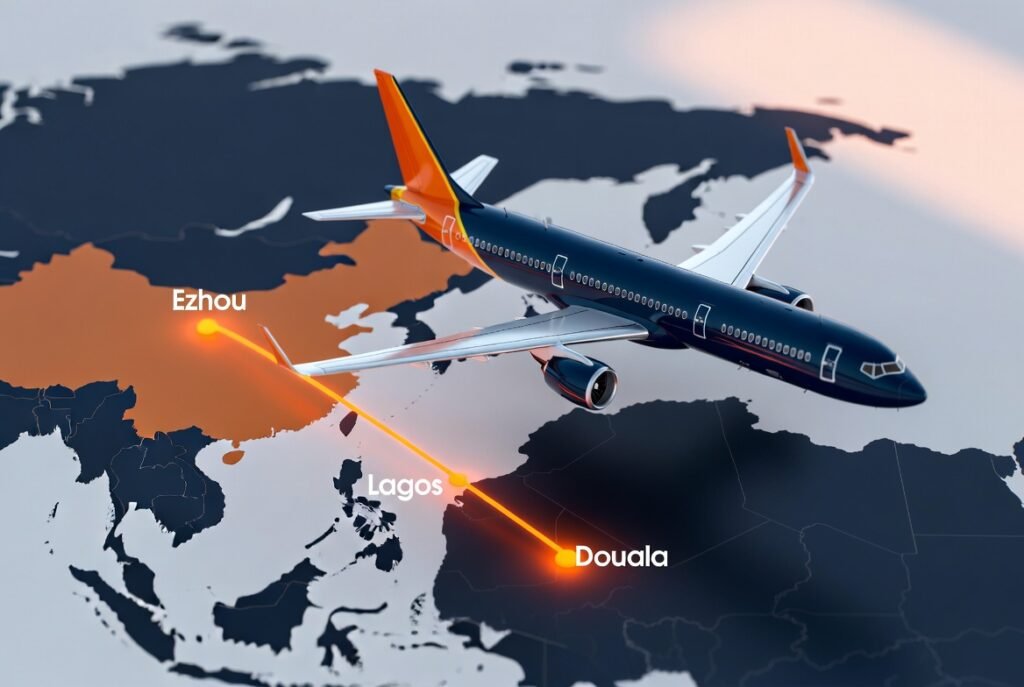
Ezhou Huahu (EHU) → Lagos (LOS) → Douala (DLA) (and onward to Kinshasa, Libreville, Brazzaville, N’Djamena, etc.)
Why the Lagos hub matters in 2026 Lagos continues to function as a high-capacity West/Central Africa gateway. Direct freighter capacity on the China–Africa lane has grown, and the hub allows better load factors and more flexible onward connections than older Europe or Middle East routings. Partnerships with operators such as Fly Business Airlines support dedicated freighter uplift (A321F, B767F class aircraft).
Service options
- Airport-to-Airport — best for agents and experienced importers
- Door-to-Airport — most common for regular importers
- Door-to-Door — recommended for first-time or high-value shipments
2. 2026 Regulatory Updates (Cameroon & CEMAC)
Cameroon and the broader CEMAC zone have accelerated digitalization:
- CAMCIS + GUCE are now the core systems. Almost all import declarations, manifests, and payments run through these platforms.
- Electronic air cargo data submission to CAMCIS is being rolled out at Douala and Yaoundé airports to cut manual entry delays.
- CEEAC–CEMAC Common External Tariff took effect 1 January 2026 (duties generally 0–40% depending on product category).
- All customs revenues must go through Tresor Pay.
- Specific electronic controls for mobile devices/tablets (IMEI-based) started in March/April 2026.
- Port of Douala is targeting full platform digitalization by September 2026, which should also benefit air cargo connectivity and transit processes.
- Import Declaration (DI) via e-FORCE / GUCE is mandatory for most commercial shipments.
Practical impact: Clearance is faster when documents are submitted correctly and early, but any error in the digital system still causes delays. Work with partners who understand the current GUCE/CAMCIS workflows.
3. Documents Required
Standard set for Douala / CEMAC air cargo:
- Commercial Invoice
- Packing List
- Air Waybill (AWB)
- Certificate of Origin (when required)
- Import Declaration (DI) via GUCE/e-FORCE
- Any product-specific permits or certificates (ANOR, health, etc.)
Incomplete or incorrect data in the digital systems is still the main cause of clearance delays.
4. How Chargeable Weight Is Calculated (With Real Example)
Airlines charge on chargeable weight = the higher of:
- Actual gross weight, or
- Volumetric (dimensional) weight
IATA standard formula (metric): Volumetric weight (kg) = (Length × Width × Height in cm) ÷ 6000
Example You have 8 cartons. Each carton measures 60 cm × 50 cm × 40 cm. Total actual weight of the shipment = 95 kg.
Step-by-step:
- Volume of one carton = 60 × 50 × 40 = 120,000 cm³
- Volumetric weight of one carton = 120,000 ÷ 6000 = 20 kg
- Total volumetric weight = 8 × 20 kg = 160 kg
- Chargeable weight = max(95 kg, 160 kg) = 160 kg
You will be billed on 160 kg, not 95 kg. Proper packing that reduces wasted space can significantly lower your cost.
5. Seasonal Rate Fluctuations in 2026
Expect higher rates and tighter space during:
- Chinese New Year period (January–February) — factories close, capacity drops
- Back-to-school season (July–September) — demand for electronics, stationery, apparel
- End-of-year peak (October–December) — Christmas, New Year, and inventory restocking across Central Africa
- Pre-Ramadan periods (varies by year)
Rates can rise 15–40% in peak windows. Booking 2–3 weeks ahead is strongly recommended during these times.
6. Insurance Options and Claims
Standard air cargo insurance (All Risks / Institute Cargo Clauses A) is widely available and recommended for shipments above a few thousand dollars in value.
- Coverage usually starts from warehouse in China until delivery or airport handover.
- Claims are handled through the airline or the freight forwarder.
- Keep original packing photos, AWB, commercial invoice, and survey report (if damage occurs).
- Most claims require prompt notification (usually within 7–14 days of discovery).
Always confirm whether insurance is included in the quote or needs to be arranged separately.
7. Douala vs Other Central African Gateways
| Airport / Port | Best For | Strengths | Limitations |
|---|---|---|---|
| Douala (DLA) | Cameroon + CEMAC transit (Chad, CAR) | Largest capacity, best China connections, digital systems improving | Congestion still possible |
| Libreville (LBV) | Gabon local market | Direct options sometimes available | Lower freighter frequency from China |
| Pointe-Noire / Brazzaville | Congo | Good for local Congo cargo | Weaker direct China air links; often needs connection |
| Kinshasa (FIH) | DRC | Growing demand | Infrastructure and clearance can be slower |
For most China-origin cargo destined for multiple CEMAC countries, routing via Douala remains the most practical choice in 2026.
8. Common Mistakes to Avoid
- Under-declaring value or using incorrect HS codes
- Ignoring volumetric weight when packing
- Booking only the cheapest rate without checking transit reliability
- Late submission of documents into GUCE/CAMCIS
- Not arranging insurance for higher-value goods
- Failing to plan around peak seasons
Ready to Ship?
Scoppar operates the Ezhou–Lagos–Douala corridor in partnership with Fly Business Airlines and provides both cargo space and agent support.
WhatsApp: +237 693 000 027 Email: care@scoppar.com Website: www.scoppar.com
Contact us for current rates, available space, or assistance with documentation and booking.